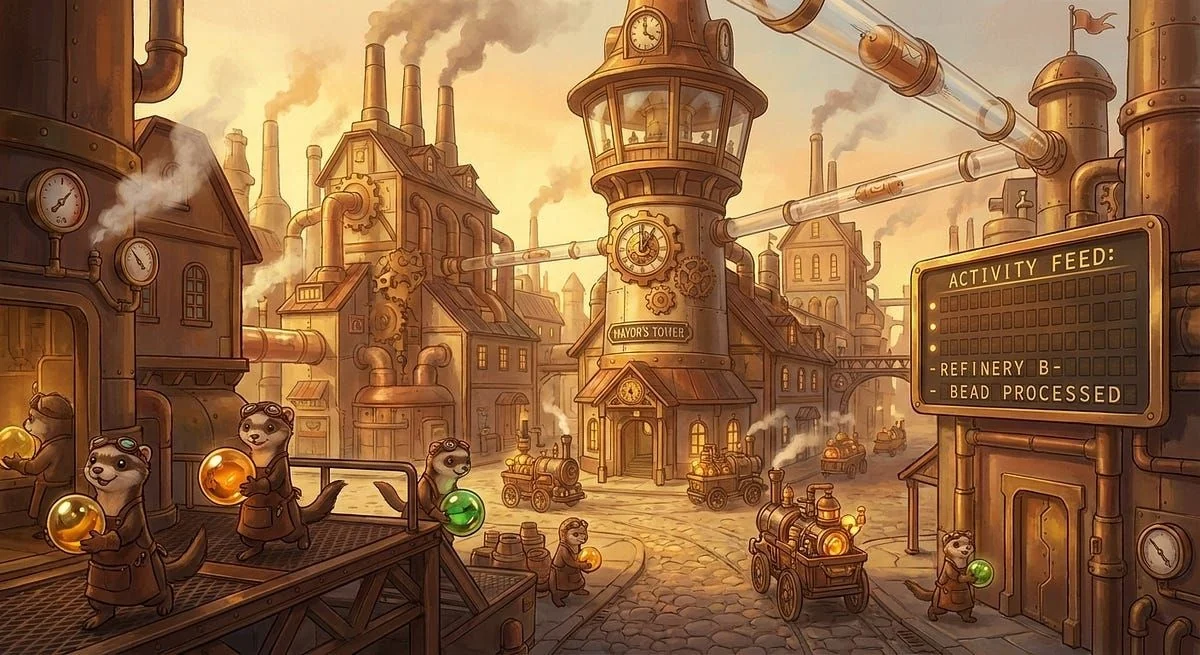
Presented live around a running demo. The embedded panels showed a local harness that isn’t running here — each one is captioned with what it displayed on the night. If a diagram fails to draw, refresh the page.
Roger & Renate Rössing · Deutsche Fotothek · CC BY-SA 3.0 DE
Zechariah Judy · via Wikimedia Commons · CC BY 2.0
NASA Glenn Research Center · public domain
Evergreen Systems, 1987 · public domain
We’ve automated labour before.
For the first time, we’re automating the building of the
software itself.
How do we do it securely?
Background
How software has been built
One role decides what to build; another turns it into
working software.
Product Manager
Owns what to build, and why: requirements & roadmap.
market · business · feedback · intuition
spec⟶
requirements
→
implement
→
test
→
release
Software Engineer
Tracking the work
The unit of work is a card. It flows left to right through fixed
stages, owned by a human at every step.
def run_agent(user_goal):
    context = [{"role": "user", "content": user_goal}]

    while True:
        # 1. REASON: Ask the model what to do next
        response = llm.call(messages=context)
        context.append(response)

        # 2. ACT: Check if the model wants to use a tool
        if response.tool_calls:
            for tool in response.tool_calls:
                result = execute_tool(tool.name, tool.args)
                # Feed the result back into memory
                context.append({"role": "tool", "content": result})
        else:
            # 3. STOP: Goal achieved, or model is done
            return response.content
LLM with some tools
Dynamic Decision Making
Feedback Loop
Exit condition
Tools
A tool is just a function the model is allowed to call, described to it as a JSON schema.
The schema is the whole interface: to the model, prompt.
It emits a JSON call; your code runs it.
Whether it runs is your call: where trust begins.
The model only ever asks. You act.
System prompt
The first, highest-priority message. Sets role, constraints, voice
and output contract before the task is even seen.
soul: security-reviewer-go
role: qa
model: claude-opus-4-8
sandbox: go-toolchain@sha256:1c2…
tools: [read_file, search, submit]
system_prompt: |
  You are a senior Go security
  reviewer. Find vulnerabilities in
  the diff: injection, auth bypass,
  secrets committed in code.
  Cite file:line and the exploit;
  do not fix. Be terse. No praise.
Same model, same loop: the prompt is what makes one agent
a planner and another a security reviewer.
It steers every turn that follows, but writes nothing back.
Persona
The stable identity that prompt encodes: its expertise, its tone,
what it refuses to do.
soul: security-reviewer-go
role: qa
model: claude-opus-4-8
sandbox: go-toolchain@sha256:1c2…
tools: [read_file, search, submit]
system_prompt: |
  You are a senior Go security
  reviewer. Find vulnerabilities in
  the diff: injection, auth bypass,
  secrets committed in code.
  Cite file:line and the exploit;
  do not fix. Be terse. No praise.
Who it is (“senior Go security reviewer”) and
how it behaves (“be terse, no praise”).
Change the persona, keep the loop: you have a different
agent.
Soul
Persona + model + tools + sandbox, captured as declarative config.
(We’ll come back to this.)
soul: security-reviewer-go
role: qa
model: claude-opus-4-8
sandbox: go-toolchain@sha256:1c2…
tools: [read_file, search, submit]
system_prompt: |
  You are a senior Go security
  reviewer. Find vulnerabilities in
  the diff: injection, auth bypass,
  secrets committed in code.
  Cite file:line and the exploit;
  do not fix. Be terse. No praise.
Stateless: no cross-task memory, reconstituted
fresh on every invocation.
One loop, many souls: identity is configuration, not code.
A factory is just a CI/CD pipeline where the build steps think.
Humans author specs. Everything merged to main is autonomous.
… but the build steps are hostile-by-assumption LLM agents.
How do you trust what they merge?
▶ live demoVault — the deployed result
The app the factory built, opened live on stage. Every line of it was written by agents from a human-authored spec.
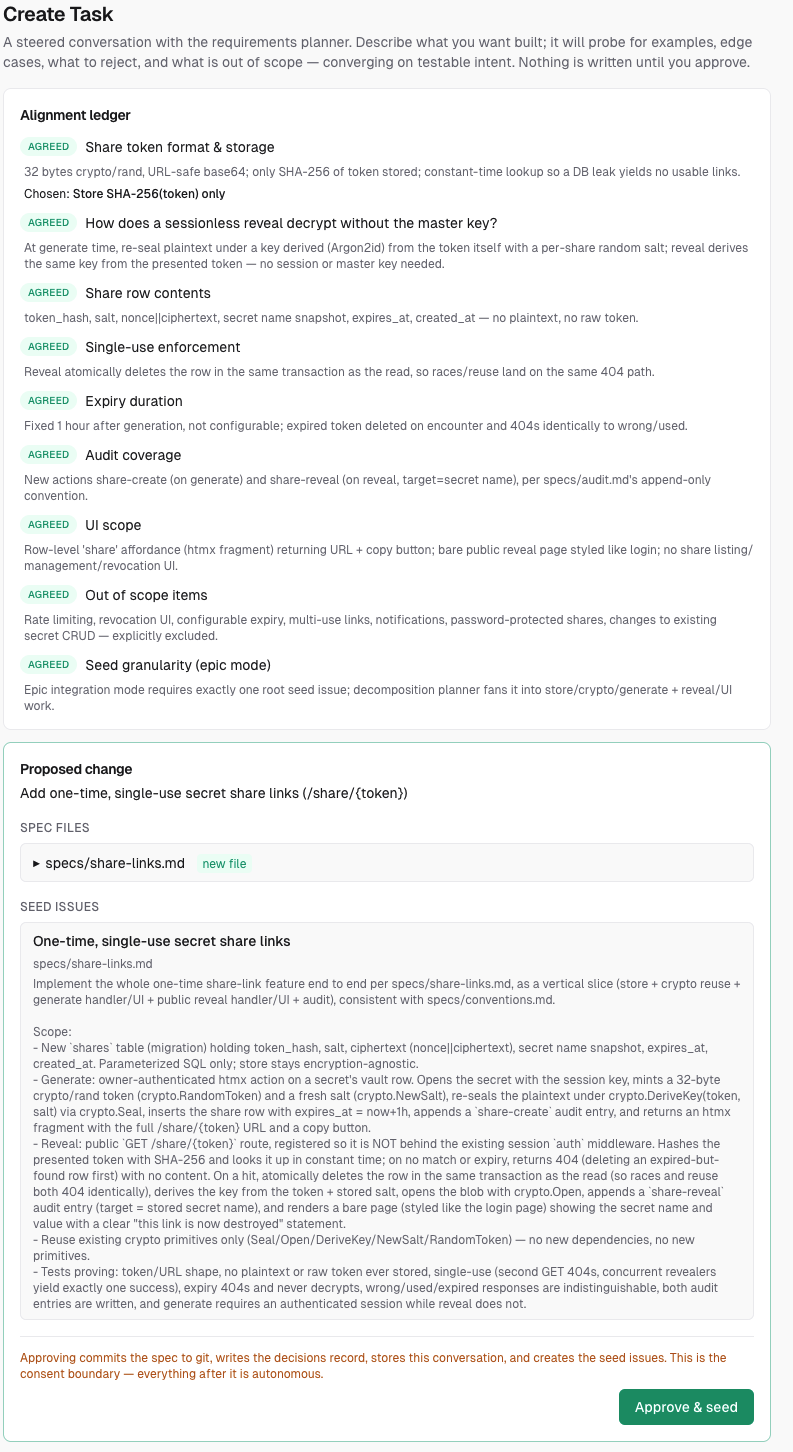
▶ live demoThe Create-Task wizard
Where a human authors the spec. The only place a person writes anything — everything downstream of it is autonomous.
Architecture
Six choices that buy back the trust
The pipeline
A human writes the spec. From there every stage is an agent, and the
graph only moves forward when the orchestrator says so.
flowchart LR
H(["human: spec"]):::t --> P["plan"] --> AT["author-tests"] --> I["implement"] --> QA["qa / security"] --> M[["integrate → main"]]:::t
QA -. "on_failure" .-> I
I -. "on_failure · retry" .-> I
classDef t fill:#2b6cb0,stroke:#2b6cb0,color:#fff;
Emergent breadth, declarative depth: an agent proposes how many
children a stage spawns; config fixes what stage comes next.
Stages compose through contracts
What moves a card forward is not the agent saying so; it’s the
orchestrator checking guards the stage declares. The agent does
the work; the orchestrator decides whether it counts.
Precondition: must hold to enter
(usually blockers-closed).
Postcondition: must hold to be accepted,
checked in a fresh verification sandbox.
on_failure: mandatory route when a gate fails.
No human in the loop, so every gate needs a destination.
The guards are abstract predicates:
tests-red-then-green says what must be true, never
how to check it.
The config behind this demo
The actual pipeline I’m running. Each stage names abstract guards;
cards only advance when the orchestrator says they hold.
dag:
  plan          →  decompose the spec
  author-tests  →  tests fail (red)
  implement     →  tests red → green
  qa            →  tests · lint
                   · static analysis
  integrate     →  autonomous → main
The graph speaks in predicates: what must
be true, never how to check it.
qa fails → on_failure routes back to
implement. No human in the loop.
… bound to real tooling
One registry maps each abstract predicate to the command that decides it.
checks:       # abstract → real tooling
  tests            go test
  compiles         go build
  lint             golangci-lint
  static analysis  gosec
                   · govulncheck
                   · licenses
Swap the command, the DAG is unchanged.
The gates are just existing tools: nothing
reinvented. Leverage what already works.
Design Principles
Learn and have fun
Customizable framework over opinionated workflow
Distributed in nature
Sandboxed
Leverage existing techniques
Strong provenance & decision-record keeping
Resilient
Untrusted by default
Every agent runs in a zero-network sandbox; the
runner brokers all I/O. The agent never holds a key or touches the
wire.
Blocks code that exfiltrates secrets, phones
home, or pulls malware: there’s nothing to phone
with.
On the board: every card you see is executing inside its own isolated
sandbox.
Producer ≠ verifier
Tests are authored by a different soul than the
implementor, and gates run in a fresh sandbox the
orchestrator controls, never the one that wrote the code.
Blocks an agent marking its own homework.
Independence is what makes a green check mean something.
On the board: author-tests and qa are separate
cards, owned by separate souls.
Single writer
Only the orchestrator writes the work graph. Agents
propose mutations via their Result; each is validated as
DAG-legal before it’s applied.
Blocks an agent rewriting the graph to delete
its own gate or jump straight to merge. It can ask; it can’t
write.
On the board: cards only move when the orchestrator says so. No
agent moves itself.
Emergent within, declarative between
Agents decide how many work items a stage produces;
config decides what stage comes next. An emergent
issue-DAG inside a fixed role-flow.
Buys bounded creativity: work fans out
as far as the problem needs, never off the rails the config lays down.
On the board: watch one issue fan into many during plan.
Bounded autonomy
Budgets and retry caps aren’t cost control; they’re
the termination guarantee. Breach a budget and the
work dead-letters for a human to triage.
Blocks an agent that loops forever, burning
money and never halting. The budget is what promises it stops.
On the board: the budget meter, and stuck work landing in the DLQ.
Provenance by construction
Every change traces
issue → soul → model → prompt → evidence, produced as a by-product of how the work is done, not logged
after the fact.
Why you can’t trust a merge you
can’t trace. Provenance is what lets a human re-enter and audit
any decision the factory made.
On the board: every merged card links its full decision trail.
Under the hood
The mechanisms behind the six choices
The sandbox
One work item, one sandbox, destroyed after. The backend is
config, not code:
Backend
Isolation
Startup
Use
Docker
shares the host kernel (weak)
fast
local dev only
gVisor
user-space kernel
medium
medium-trust
Firecracker
own kernel (KVM microVM)
~125 ms
production target
Images are digest-pinned: a soul names a logical
profile, infra resolves the digest, and the digest rides in provenance.
The trust boundary
One chokepoint: the sandbox can only reach its runner; the runner brokers
everything else.
flowchart LR
subgraph SB["producer sandbox · zero-network · untrusted"]
A["agent"]
end
subgraph TR["trusted layer"]
R["runner · holds key + adapter"]:::t
O["orchestrator · sole beads writer"]:::t
end
subgraph VB["verification sandbox · fresh · deny-all"]
V["gate · re-runs candidate"]
end
subgraph EG["allowlisted egress · logged · deny-by-default"]
X1["model API"]
X2["git · task branch only"]
X3["Go module proxy"]
end
A <-->|"local socket · the only channel"| R
R <-->|"NATS"| O
R --> EG
O -->|"provisions · producer ≠ verifier"| V
classDef t fill:#2b6cb0,stroke:#2b6cb0,color:#fff;
Zero network, zero credentials, one allowlisted window — and that
window doubles as the observability collector: every
call, span, and transcript flows through it.
The whole record, live
▶ live demoOpenObserve — the whole record
Live traces, logs and metrics from the running pipeline: every agent action, tool call and gate decision, end to end.
One orchestrator, many runners
One orchestrator hands work to a queue; any number of runners, across any
number of hosts, compete to pull it.
flowchart TB
O["orchestrator · single scheduler · sole beads writer"]:::t
JS[["NATS JetStream · work · results · dlq · approvals"]]:::q
O <-->|"dispatch work · collect results"| JS
subgraph HA["host A"]
R1["runner · agent in sandbox"]
R2["runner · agent in sandbox"]
end
subgraph HB["host B"]
R3["runner · agent in sandbox"]
RN["runner N · agent in sandbox"]
end
JS <-. "pull · compete · ack = lease" .-> R1
JS <-.-> R2
JS <-.-> R3
JS <-.-> RN
classDef t fill:#2b6cb0,stroke:#2b6cb0,color:#fff;
classDef q fill:#eef5fb,stroke:#2b6cb0;
Souls
Soul = identity
Declarative config: name, role, model, persona, tools, sandbox profile.
Stateless: no cross-task memory, reconstituted
fresh every invocation. All durable state lives in beads, git, and specs.
Agent = behaviour
Everyone runs the same loop. A role’s behaviour is
its persona plus which tools are enabled: planner, test-author,
implementor, and security agents all share one loop.
Souls fulfil roles, chosen per-issue by a selector; you scale
by adding runners, not souls. This is what makes
producer≠verifier concrete: implementor-go is a
different soul from test-author-go.
No framework
No agent framework, no Claude Code: the loop, the tool dispatch, and
every schema the model calls are custom.
Read
read_file · list_dir · search
Semantic · gopls
find_symbol · references · diagnostics …
Edit
write_file · edit_file · rename · code_action
Execute
run · run_tests · run_gate
Trace
trace_test → test↔spec map
Propose
submit_plan · submit · request_subtask · escalate
Explore — a sub-agent as a tool
explore: broad question → distilled {summary · file:line anchors · leads} — a nested loop on a cheap model; it burns its own context, not mine
When a gate fails
No human reads the log — a red gate has to be actionable.
Red gate
build first · tri-state · never a false green
⟶
Typed findings
file:line · rule · severity — raw output kept as evidence
⟶
Brief → retry
the next attempt sees the findings — the loop learns
Provenance, for real
Every merge to main is a harness-authored,
SSH-signed provenance commit: